
Muscle Protein Synthesis Explained: How Muscle Actually Grows
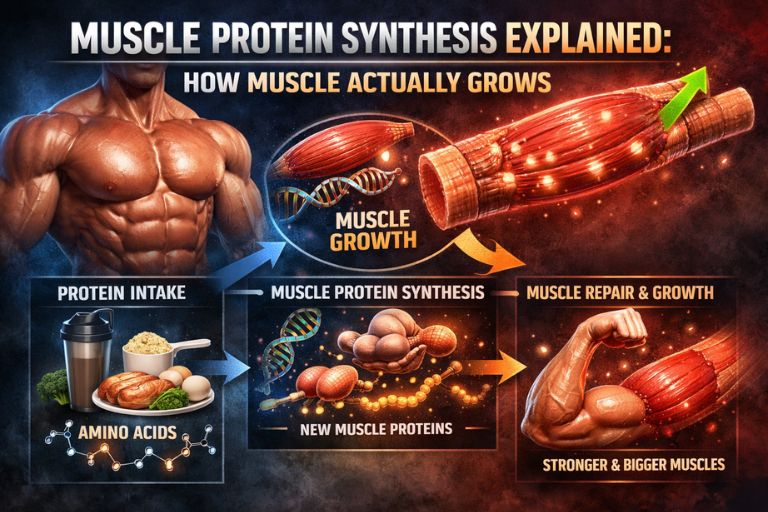
Muscle Growth Is Not What You Think
If building muscle were as simple as lifting weights and drinking protein shakes, everyone who trains consistently would look muscular.
But that’s not reality.
The biggest misunderstanding about muscle growth is this: people think muscle is built during workouts or immediately after eating protein. In truth, your body is never simply “building muscle” — it’s constantly doing two things at the same time: building and breaking down muscle tissue.
Every day, your body is in a state of turnover. Some muscle proteins are being synthesized, while others are being broken down. Training and nutrition don’t magically create muscle — they shift the balance between these two processes.
And that balance is what actually determines whether you gain muscle, lose it, or stay the same.
Muscle growth is not a single event. It’s the result of consistently tipping the scale in your favor over time.
The Only Rule That Matters: MPS vs MPB
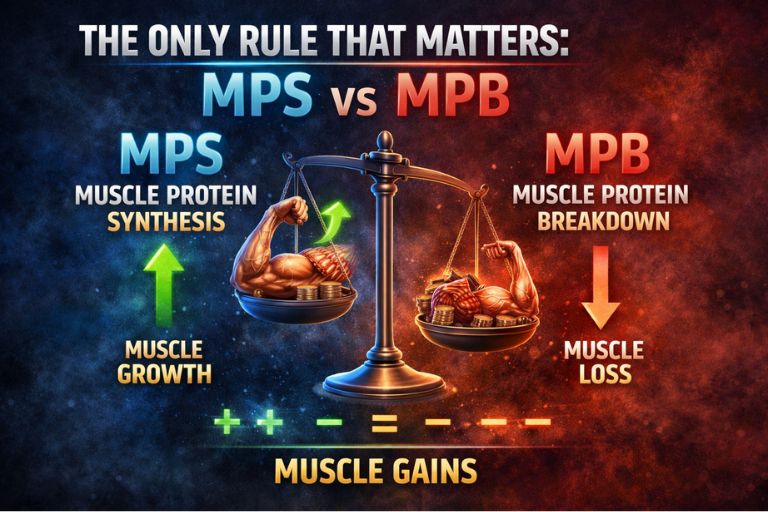
To understand muscle growth, you only need to understand one concept:
- Muscle Protein Synthesis (MPS) → building new muscle proteins
- Muscle Protein Breakdown (MPB) → breaking down existing muscle tissue
These two processes are always happening — not just after workouts, and not just when you eat protein.
The key is how they compare over time.
You only build muscle when MPS is greater than MPB consistently
Not after one workout.
Not after one high-protein meal.
But over weeks and months of repeated stimulus.
This explains why:
- You can train hard but not grow if recovery and nutrition are poor
- You can eat a lot of protein but not grow if your training lacks intensity
Because neither training nor nutrition works in isolation. They both influence the same system — just from different angles.
A helpful way to think about it is like a tug of war. Muscle growth happens when the “building side” pulls harder than the “breakdown side” over time.
What Actually Triggers Muscle Growth
Once you understand that muscle growth is about balance, the next question is: what actually shifts that balance?
There are three key drivers, and each plays a different role.
Resistance Training: The Signal
Lifting weights creates mechanical tension in your muscles. This tension acts as a signal that tells your body:
“We need to adapt to handle this level of stress.”
Without this signal, your body has no reason to build additional muscle — no matter how much protein you consume.
Protein Intake: The Building Material
Protein provides amino acids, which are the raw materials used to build new muscle tissue.
If training is the signal, protein is what allows your body to respond to that signal. Without enough protein, the process is limited — not because the signal isn’t there, but because the resources are missing.
Leucine: The Trigger
Leucine, an essential amino acid, plays a key role in initiating muscle protein synthesis. It helps activate the internal pathways that tell your body to start building.
Think of it not as the builder, but as the switch that starts the process.
The most important takeaway here:
Training creates the demand.
Protein provides the supply.
And specific amino acids help initiate the process.
You don’t need one of these — you need all of them working together.
Why More Protein Doesn’t Mean More Muscle
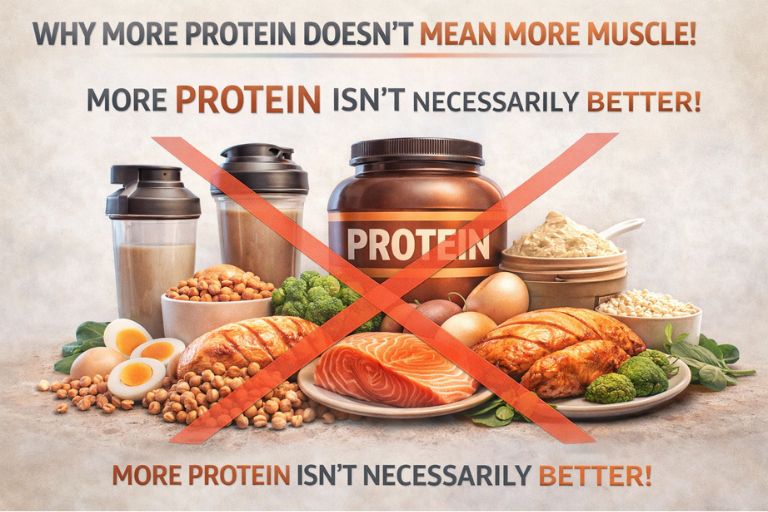
A common belief is that eating more protein will always lead to more muscle growth. But the body doesn’t work that way.
Muscle protein synthesis has a limit. After a certain point, consuming more protein in a single sitting doesn’t further increase the rate of muscle building.
A simple way to think about it:
it’s like pouring water into a glass that’s already full — the excess doesn’t add anything useful.
This is why extremely high protein intake, especially in one meal, doesn’t automatically translate to more muscle.
What matters more is:
- total daily protein intake
- distributing it in a reasonable way
Not trying to overload your body all at once.
The Biggest Myths About Muscle Protein Synthesis
There’s a lot of confusion around MPS, mostly driven by oversimplified advice and supplement marketing.
Myth 1: Protein Timing Is Everything
While timing can have a small impact, it’s far less important than total daily intake. Missing a post-workout shake won’t ruin your progress.
Myth 2: More Protein = More Muscle
As mentioned earlier, there’s a limit to how much your body can use at once. Beyond that, more isn’t better — it’s just excess.
Myth 3: Supplements Boost Muscle Growth Directly
Most supplements don’t “increase MPS” in a meaningful way. Even products like Protein Powder One are useful mainly for convenience, not as a shortcut to muscle growth — they still depend on proper training and overall nutrition.
The common thread across all these myths:
People look for shortcuts — but muscle growth doesn’t come from hacks. It comes from consistency.
How to Actually Use This Information
Understanding MPS is useful — but only if you apply it correctly.
Instead of focusing on small optimizations, prioritize what actually matters:
- Train with enough intensity and progression
Without a strong stimulus, nothing else works. - Consume enough protein daily
This supports your body’s ability to build muscle over time. - Stay consistent over weeks and months
Muscle growth is cumulative, not instant. - Treat timing as a minor factor
It can help, but it won’t make or break your results.
At the end of the day, muscle protein synthesis isn’t something you “hack” or dramatically boost with a single trick.
It’s a process you support — through training, nutrition, and consistency — over time.
And that’s what actually leads to real, sustainable muscle growth.